Friday, March 30, 2012

15 Ways to Keep Your Employees Happy

How motivated are your workers? We asked 15 successful young entrepreneurs to share secrets to sparking happiness and company loyalty around the office.

The Young Entrepreneur Council asked 15 successful young entrepreneurs to explain their secret for keeping their start-up employees happy and motivated. Here are their best answers.

1. Have a Little Faith in Hires

If you hired these people, you should trust them to do their job. Entrepreneurs like to keep everything close to their chest, but you can move quicker and more creatively if you give your employees the autonomy to complete their projects with direction, but without micro-managing. Don't overestimate the cost of small failures.
Ryan Stephens, Ryan Stephens Marketing

2. Ask How They Are...and Actually Listen

A simple "How are you?" means so much. Employees will either smile and say "fine" or use the opportunity to express a concern. I've had jobs where my boss never asked that question, and I didn't feel valued. Asking such a simple question is a free way to show your employees that they are being heard.
Nancy T. Nguyen, Sweet T

3. Concert Tickets, Anyone?

As a bonus for one of our employees, I decided to pull some strings and get her tickets to a sold out concert here in town. I think that giving them memorable experiences far outweighs any monetary gift you can give them. When she heard she got the tickets, I had never seen her light up as much as she did and she's kicked her work into high ground ever since.
Greg Rollett, The ProductPros

4. Stretch the Flexibility

Everyone has a different work rhythm; some employees are most productive early in the morning while others prefer burning the midnight oil. Other than our daily 10-minute meeting before noon, our employees can work whenever they'll be most effective, as long as they communicate their schedules and meet their deadlines. This freedom shows we have faith in our employees, and yields amazing results.
Bhavin Parikh, Magoosh

5. Too Cool for School? Think Again.

Everyone wants to learn more and improve their skill sets, so one of many favorite ways to keep startup employees happy and motivated is to provide them with opportunities to learn. Whether its enabling them to take time to attend an interesting conference or paying for a niche networking event, learning keeps people engaged and shows you care for their long-term personal and professional success.
Doreen Bloch, Poshly

6. Freedom in Fluidity

In the startup world, it's not always about hiring someone to fill a specific role. Rather than defining explicitly what your new hire should be doing, let them act as a partner in the business in defining their role. This allows them to focus on what they're passionate about, while still contributing what you need for the business.

Matt Cheuvront, Proof Branding

7. Light Up That Ladder!

Unlike large corporations, startups have the true ability and flexibility to empower their employees and make them feel like they are a part of the bigger picture—simply because they really are. Every single employee is incredibly valuable because they have such a deep impact on how the business grows. Make your employees understand that they can grow with you as they help the company grow.
Justin Beegel, Infographic World

8. Tailored Rewards

One thing that a small start-up can do—that a large corporation has a tougher time of doing—is asking employees how they'd like to be rewarded. Attend an upcoming conference? A more flexible schedule? The newest iPhone? Your employees will feel good that you've actually taken the time to get to know what they'd like in exchange for a job well done. Oh, and they'll actually work for it too! —Caitlin McCabe, Real Bullets Branding

9. They Don't Call It Happy Hour for Nothing!

Once a quarter, I take everyone out for dinner and drinks. After a drink or two, people start to feel more relaxed and give you feedback that they wouldn't otherwise share. It's not a trick its sort of our system. Everyone knows these events are say what ever you want to say and I'll listen.
Roger Bryan, RCBryan & Associates

10. Team Transparency and Collaboration

Every Monday, we have a meeting to define goals and go over the schedule for the week. This is not just a time for people to report what's on their list, but more importantly, it is an opportunity for everyone to get involved in all of the projects. We give the whole team an opportunity to give their input, and allow them to add value. The result is a stronger company culture and better products.
Bobby Emamian, Prolific Interactive

11. Create Intrapreneurs

Let your employees work on a project of their own choice, but one that will benefit the company. You will quickly realize the unidentified talents of your workforce, create solutions to problems you may not even have known existed, and improve employee morale.
Benjamin Leis, Sweat EquiTees

12. Give Promotions When They're Earned

When someone has really impressed you, promote him or her with a title change or increased or different responsibilities. If you can afford it, give them a raise or bonus. Showing that you recognize their achievements and dedication in some way is important in retaining talented employees and keeping them happy.
Heather Huhman, Come Recommended

13. Invest Beyond Business Matters

I recently offered my employees an extra $100 cash to read a book I picked out for them. The book was entrepreneurship/productivity related, and I know that reading that book will make them better employees. They get some money and a feeling of empowerment, while I get smarter, more productive employees.
Lucas Sommer, Audimated

14. A Good Ol' Gathering at the Grill

There is nothing like kicking back and firing up the grill with a great group of people. When things are laid back, everyone is at ease and it gives you a chance to learn more about them outside of work. A company is one big family, and when an employee feels like they have a second family during the day, they then look forward to coming to work.
Ashley Bodi, Business Beware

15. Are You Happy and Motivated?

Lead by example by being happy yourself. Be caring of your team, demonstrate pride in the company, acknowledge achievements both big and small. Put forth the same positive attitude that you want others to have.
Nicolas Gremion, Free-eBooks.net

Thursday, March 29, 2012

Quote of the Day

"Be not afraid of going slowly. Be afraid of standing still."
Japanese Proverb

Your action for today is to reflect on a goal or project where you have not seen the amount of progress that you'd like. Be sure to celebrate the progress that you've made.

Wednesday, March 28, 2012

Quote of the Day

"If you can't learn to do something well, learn to enjoy doing it badly."
Baseball Analyst, Bill James

Your action for today is to identify something that you're not very good at, and by looking at it with a new perspective find something to like about it.

Cool Tools


Clarify-It - Very nice little innovation that allows you to capture, sequence and annotate screenshots to create documents that are a great alternative to screen recordings.

Boun.cr - Interesting startup that offers email shortening, kind of like bit.ly for email, but also allows you to share your short address publicly without the worry of spam.

PDFtoHTML - This converter allows you to convert any PDF document into an HTML page.

Tuesday, March 27, 2012

Heart attack predicted weeks in advance via simple blood test

By Janet Fang | March 21, 2012, 9:00 PM PDT


A simple test that spots abnormal cells coming from the lining of blood vessels can predict a heart attack a week or two beforehand.

Heart attacks happen when fatty deposits in an artery burst open. A blood clot forms to seal the break, but if that gets too big, it blocks off blood flow.

Blood vessels are lined with ‘endothelial cells’ that control the ability of arteries to widen and prevent clots. When there are a lot of large, misshapen endothelial cells, a heart attack is imminent, the new study shows.

More than 2.5 million Americans experience a heart attack or stroke. While doctors can tell who’s at risk – people with high blood pressure and cholesterol, who smoke, have diabetes, are overweight or sedentary – there’s no way to tell when a heart attack is looming.

People often head to the hospital when they feel chest pain or pressure, only to be sent home when doctors can’t detect a problem with an EKG. They currently rely on the treadmill stress test, which can only determine if there’s an artery blockage – not if there’s a crack in the artery or if the plaque is poised for rupture.

(Basically, we can only tell if a person is currently experiencing or has recently experienced a heart attack.)

“The ability to diagnose an imminent heart attack has long been considered the holy grail of cardiovascular medicine,” study researcher Eric Topol from the Scripps Research Institute says in a release.

Sometimes people pass the stress test, only to have a heart attack in the next few days. To help flag these patients, Topol and colleagues developed a blood test with the help of 44 healthy volunteers and 50 patients who had gone to emergency rooms with heart attacks in San Diego.

    First, they isolated and counted ‘circulating endothelial cells’ (CECs) coming from the inner lining of blood vessels.
    Then using fluorescent images, they revealed that CECs from heart attack patients look very different from those in healthy people: abnormally large, misshapen, and contain more than one nucleus.

CEC levels in heart attack patients are over 400% higher than in healthy people. “These are sick cells that have been subjected to profound inflammation,” Topol explains.

(Pictured on the right, CECs from heart attack patients. On the left, normal CECs.)

The team hopes to have this test developed for commercial use within the next 2 years. AP reports:

    Topol said his team soon will begin needed studies to learn how early those cells might appear before a heart attack, and if spotting them could allow use of clot-preventing drugs to ward off damage. Some San Diego emergency rooms will study an experimental blood test with chest-pain sufferers whose standard exams found no evidence of a heart attack.

In the future, patients at risk could have a nanosensor implanted in a vein to detect the abnormal cells and then send an alert to their phone.

The study was published in Science Translational Medicine today.

Image: Scripps Translational Science Institute

Friday, March 23, 2012

10 Signs Your Marketing is Totally Outdated

Marketing isn't only about what you're pitching, but also about how you deliver the message. We've asked a slate of successful young entrepreneurs what not to do.

The Young Entrepreneur Council asked 10 successful young entrepreneurs to name one business development or marketing strategy that companies are still using, but that is annoying, irrelevant, or simply out of date. Here are their best answers.

1. You're cold calling? That's not hot.

More importantly, cold calling with blind intent. When marketing your product or service, don't pick up the phone and spit out a sales pitch. Research potential partners, clients, and consumers, and tailor your pitch to them. The spray and pray, quantity-over-quality approach rarelyif everworks in today's crowded and innovative marketplace.
Matt Cheuvront, Proof Branding

2. You're still prioritizing sales over success.

Customer retention and loyalty are all the rave now. When businesses focus only on sales and fail to provide adequate post-sale service, customers will never return again. But if a business goes above and beyond to ensure their products continue to satisfy their customers, the returns are unbelievable.
Danny Wong,Blank Label Group

3. You're still serving spam!

Fifteen years ago, we all looked forward to the words "You've got mail!" Every email was precious, even if it was from a business trying to sell us something. Nowadays, due to the sheer volume of emaiIs we receive, it's a struggle to read every subject line. Yet businesses still send cold emails rather than spending 10 minutes on LinkedIn to look for a qualified introduction. Bhavin Parikh, Magoosh

4. You're fixated on the clock.

Companies can no longer view business development as a 9-to-5 job. More than ever, BD professionals tirelessly look for opportunities to further the business. Online media has bolstered this trend. BD professionals are using their personal social networks to bolster their business responsibilities too. BD is no longer confined to office hours.
Doreen Bloch, Poshly

5. You put it in snail mail.

I can't think of a single time in my entire life that I've received something unsolicited in the mail and actually purchased the product or service Perhaps if I sign up for something in the tech space, and other tech companies reach out, that's at least a little targeted. But the random mass mailings are a complete waste.
Justin Beegel, Infographic World

6. You go by the script.

This mostly comes down to outdated over-the-top sales pitch language. You see it in the retail industry as well as larger organizations that supply their sales teams with scripted programs to sell. Social media has changed the way that we connect, so when people are approached in this outdated style, they really don't like it. Sales teams should learn to connect to people, not sell people.
Caitlin McCabe, Real Bullets Branding

7. You're selling specs rather than vision.

Simon Sinek nailed this in his book,Start With Why. People don't buy what you do, they buy why you do it. This is the single most profound and useful concept my business partner and I learned in 2011. So many companies are focused on the whatthe features and statswhen all the customer wants is to feel good about what you do. They must believe what you believe. Sell the vision, not the specs.
Scott Dinsmore, Live Your Legend

8. You're promoting, not providing.

Managers can be under tremendous pressure and the front line sales people are forced to meet expectations at the cost of the customer experience. I would contend that marketing and selling is simply an effort to find those who are already looking for your services or product. Focus on quality and you won't have to twist any arms. Less promoting, more providing.
Evan Kirkpatrick,Wendell Charles Financial

9. You're trying to be first in the phone book.

Many individuals that practice within what I call "referral" industries, or verticals such as law, medical, and insurance still try and use cold networking to drive new business. Unfortunately, when people search for a doctor, lawyer, or insurance agent they seek out a referral from a trusted friend or family member. Businesses in these industries should develop a referral building strategy.
Benjamin Leis, Sweat EquiTees

10. You're using social media like a machine.

How many times have you seen a business try to get social, by setting up a Twitter or Facebook account, only to simply schedule advertising messages? Then they wonder why it isn't working! Social media is about engagementpeople don't want to see only ads related to your business. That's what TV is for!
Brad Kendall, Digihedron

Thursday, March 22, 2012

Keep Those Customers!

Having respect for your customers will ensure their faith in and loyalty to you and your business. Studies show that it is nine times more difficult to attract a new customer than it is to retain an existing one, so it is critical to keep your customers happy. Surveys, focus groups and questionnaires are among the ways to measure your customers’ perceptions of you and determine how to improve.

If you discover that a customer is dissatisfied, take action immediately to win back their confidence in the services you provide. People like to know that their opinion counts and if they feel like you care about what they think, they will think positive thoughts about you and your business.

In just 60-seconds, you’ll learn how to manage upset customers and turn them into long-term, satisfied customers.

0:60 Stay Calm
Listen carefully to your customers' complaints without interrupting. Acknowledge that there is a problem and empathize with upset customers. Let them know what you can do for them and make them aware of all of their options. Always treat your customers with respect. Customers should sense that you are calm, but concerned. Your attitude when dealing with upset customers should be professional, mature, pleasant and reasonable.

0:46 Work at Gaining Loyal Customers
The number one reason that customers stop buying from a business is because they were treated poorly by someone. It is much more cost effective to retain loyal customers than to gain new ones. In order to create loyalty, you have to calm down upset customers and ensure them that you will work to find a solution that they deem acceptable. Let them know that their business is important. Thank them for their patience and cooperation. In many cases, it pays to reward upset customers in order to keep their business.

0:38 Look & Act Professional
A first impression is a lasting impression. Your appearance should signal that you are professional, mature and knowledgeable. Nonverbal communication also says a lot. Your body language and tone of voice should be polite and tactful. Pay attention to your facial expressions, posture, gestures and speech.

0:20 Choose Who You Want to Do Business With
There are some people who will never be happy with your products or services. Repeated complaints from a customer and terminal dissatisfaction are signs that you cannot please him or her. Your business is better off without such customers and you may want to refer them elsewhere.

0:11 Ensure that Mistakes Aren't Repeated
Once you determine the problem and how it originated, you can take steps to ensure that it does not happen again. Learning about a problem can actually help improve your business if you make sure that the problem is avoided in the future. Don't make the same mistake twice. In dealing with upset customers, you also learn about human behavior and become better at resolving similar situations in the future.

0:03 Don't Take Criticism Personally
Many discourteous customers act that way because they made a mistake and want to blame someone else. Don't let these customers get to you by responding emotionally or giving in to outrageous demands. Tears, anger and sarcasm are inappropriate reactions.

View more at Score.org

Wednesday, March 21, 2012

Why Color Blindness is No Longer a Problem for Web Design

Color blindness is a slight inability to distinguish colors. This can be a real drawback for anyone in the design field since the color theory is a basic feature of a successful design, and lots of decisions are based on the feeling and emotions derived from design decisions.

Have you ever considered color blindness when designing a UI? Well, even if not here are some useful tips that will help produce a colorblind-friendly website.

It is remarkable that approximately 8% of all Caucasian males and 0.5% of females experience problems with some forms of color deficiency, and it means that 1 of 20 users may not be able to see your website in its full beauty. For these viewers the text may be fuzzy and images may be unrecognizable.

Why Color Blindness is No Longer a Problem for Web Design

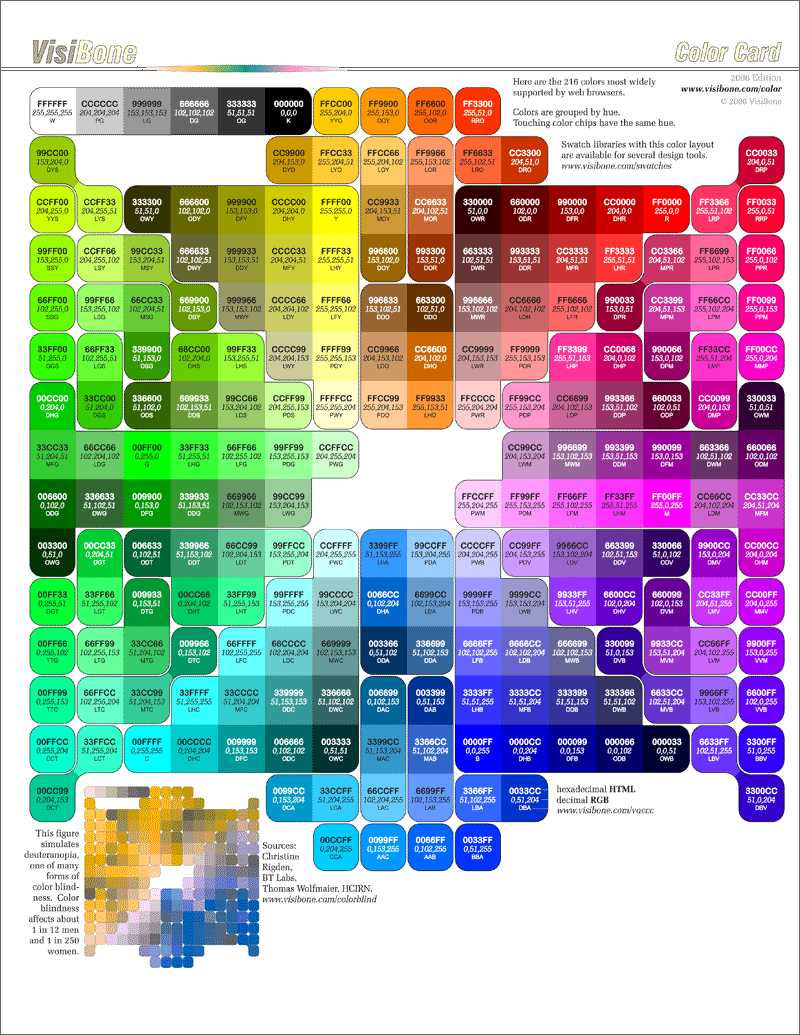
When designing a web page or any other UI, it’s really hard to take into consideration the special needs of these people. Below you can see the web designer’s Color Card with a color scheme that visualizes how people with some sort of color blindness experience colors. Judging by the scheme, we can see how color vision deficiency causes individuals to confuse reds and greens.

Why Color Blindness is No Longer a Problem for Web Design

Normal vision is trichromatic, it means that most of us can match any color or tone by a mixture of three primary colors (red, green and blue). Dichromats (people with color deficit) can match colors by a mixture of two colors. The above-featured inset visualizes how people with color deficit in this case red-green defect experience the colors and tones.

Tips for Designing Colorblind-Friendly Content


When designing web content that is friendly for color blinded people there is no need to transform all images into black and white, you may do just some slight adjustments by following several tips.

It is highly important! You need to be sure that colors you use do not convey important information.

As a rule, when the picture is uploaded onto the web its color does not really matter for the user, everyone will understand the image and its visual message if it is presented in full color or black and white. If it’s very important to provide some information with a specific image, it is necessary to use other means that would deliver this information. A good example is a map of London Underground where the routes are distinguished in color. For color blinded people it is very hard to differentiate one route from another (with these two examples taken), that is why it’s very important to use other means to define those routes.

Why Color Blindness is No Longer a Problem for Web Design

Extra approaches to differentiate colors may be useful not only for color blinded people: those who are blind may also experience problems with color reproduction and need extra cues to distinguish colors.

Color-sighted people also interpret colors differently. Color is a matter of perception that is why you will not be able to make everyone see the same colors as you see them.

How does impaired vision affect color perception?

There are hundreds of factors that influence our eyesight to mix up colors. Two colors with sharp contrast may be less distinguishable for people with some sorts of visual disorder. When producing various UIs designer needs to keep in mind that contrast between colors makes them more or less discernible rather than the individual colors themselves. Below you can find some tips for making effective color choices:

Why Color Blindness is No Longer a Problem for Web Design

  • You need to exaggerate the difference between the foreground and the background and avoid using colors with similar lightness no matter how they differ in saturation or tone.

Why Color Blindness is No Longer a Problem for Web Design

  • It is wrong to think that the lightness of the images you embrace will be the same for people with color deficit. So, if you lighten light colors and darken the dark ones, you will increase its visual accessibility.

Why Color Blindness is No Longer a Problem for Web Design

  • This diagram shows why it is preferable to choose dark colors with hues from the lower half and light colors from the upper half. It is essential to avoid making the contrast between light colors from the bottom half against dark colors from the top half.

Why Color Blindness is No Longer a Problem for Web Design

  • The color blindness effect makes the colors on the bottom part not so effective comparing with the colors from the upper part.

Why Color Blindness is No Longer a Problem for Web Design

  • You need to avoid using the contrasting hues from the adjoined parts of the circle if those colors do not contrast in lightness.

Why Color Blindness is No Longer a Problem for Web Design

  • Color blindness or partial inability to differentiate colors makes it harder to define the hues of a similar color.

Making a suitable design for all forms of color blindness can be very difficult. If you keep in mind the following basic perceptions of color, you can create UI that would fit people with color deficit. So hue, saturation and lightness can determine color perception:

  • Hue is the spectral wavelength, represented by the outside edge of a color wheel (red, orange, yellow, green, blue, violet);
  • Saturation is the scale from grey at the center of the color wheel to the pure vivid color at the edge, sometimes called shade;
  • Lightness is the level of darkness or lightness, sometimes called tint;

Hue<, saturation and lightness are the main attributes of color that can be defined as a whole.

Why Color Blindness is No Longer a Problem for Web Design

Hue varies around the lightness and varies from top to bottom; saturation is a distance from the center.

Why Color Blindness is No Longer a Problem for Web Design

Hue is an attribute which is associated with the main color names. It allows us to define main color categories (blue, green, yellow, red and purple). The normal color vision allows to define hues one to another according to their similarity and on the contrary color blindness lessens the ability to follow the correspondence of those hues.

Why Color Blindness is No Longer a Problem for Web Design

Lightness is an amount of light reflected from a specific object in correspondence with nearby objects. This color attribute is purely perceptual and makes the contrast more effective. Color blindness diminishes the ability to define color on the basis of lightness.

Why Color Blindness is No Longer a Problem for Web Design

Color blindness makes the person see the left part of this image as the one with normal color vision sees the right part. Because of the color blindness people are not able to differentiate colors on the basis of these three attributes (hue, lightness and saturation). Web designers can diminish this deficit by increasing the difference between those attributes.

Is There Any Solution for Color Blind Users?

Since there is no special treatment of color blindness, except for the color eyeglasses or lenses that could improve and sharpen person’s recognition of colors, there’s special software that allows to adjust your monitor picture according to your special needs. Here is Visolve, the software produced for people with color deficit.

Visolve allows to transform colors on the computer or an iPhone display into the corresponding colors. This software helps people with color blindness to see a normal color and to feel the color changes according to the scenery.

Why Color Blindness is No Longer a Problem for Web Design

Visolve executes following color transformations:

  • Red – Green transformation, makes reds brighter, and greens darker;
  • Blue-Yellow transformation, makes blues brighter, yellows darker;
  • Increases saturation;
  • Filters – darkens all colors other than the specified color;
  • Hatches – draws different hatch patterns depending on the color.

When people with color blindness use this software and apply, for example Red-Green transformation while keeping in mind the color changes, they can easily guess a normal color. By the way, Red-Green transformation reflects the degree of color saturation into its brightness meaning that colorblind people can see not only the difference between red and green but also the difference between two reds (the degrees of red).

Chances are that some people are color-blind, but aren’t even aware of it. So, it may be useful to pass several color blindness tests for you to find out whether or not you experience color differentiation problems.

Why Color Blindness is No Longer a Problem for Web Design

Concluding everything said above, you need to keep in mind that it’s really easy to make a colorblind-friendly website/UI. You need to put a conscious effort where it affects the way how the site works or when color perception can impair the text readability. Make sure that when it matters with links, charts or games, you look for ways to add contrast.

Why Color Blindness is No Longer a Problem for Web Design

Use highly contrasting colors, implement patterns, apply symbols, and use tricks with strokes, shadows and make sure there is significant visual difference in all the right places. It can be really helpful to use color blindness simulator to see how this or that design decision may affect overall experience. Plus keeping in mind these tips you will create a color blind-friendly UI.

  • Do not use colors to convey important information;
  • Increase contrast between similar colors;
  • Lighten light colors and darken the dark ones;
  • Increase saturation of colors;
  • Use patterns, symbols and strokes.

Drop a line below and let us know if you ever considered colorblind users when designing a site and how you accommodate their needs. Or if you experience color blindness how it affects your user experience.

Images presenting color contrast are the property of Lighthouse International. List of other resources used:
Visibone.com
Designshack.net
Webaim.org
Digital-web.com

Written by Alex


Cool Tools

Which Test Won - Great site that features lots A/B Test & Multivariate Testing Education for Marketing Professionals.

Napkin Labs - Cool little Boulder CO company making apps that provide more Facebook engagement.

Diagrammer - Nice new initiative from Duarte Design - library of fully designed diagrams that can be purchased for .99 cents and added to your PowerPoint presentations.

Wednesday, March 14, 2012

Cool Tools

PunchTab - unique service that makes it very easy to create more user engagement on you site with loyalty programs, giveaways and badges for achieving milestones.

Intercom - this newish tool allows you to create far more user engagement with folks that frequently visit your site or app. You can gather social data and interact with frequent visitors.

Speaker Deck - great, simple way to share slide deck presentations online.

Thursday, March 8, 2012

Eric Schmidt-Backed Slice Brings Receipt Aggregator And Tracking Service To Android Devices

Eric Schmidt-backed receipt tracking service Slice is bringing its handy, organizational platform to Android devices.

Slice offers Yahoo Mail, Gmail and iPhone apps that help you organize your online shopping by analyzing your inbox. It’s sort of like what TripIt does for your itineraries, except Slice tracks receipts, notices and purchases.

Once you sign up, the app automatically aggregates and pulls information from the electronic receipts in your email and organizes it in one place. The startup says that receipts and purchases often gets lost in your inbox and the app consolidates your shopping history in one place so you don’t have to log into multiple websites, dig through receipts or manually file emails. Slice for the iPhone gives you access to all this information on the go.

With the launch of the Android app, users will also be able to view and organize purchases made using Google Wallet. The app will track all your in-progress shipments on a single map as they make their way to your front door, with detailed information about the contents of the package and where it is coming from. Push notifications let you know when a purchase has shipped and when it gets delivered.

Slice will also give you historical purchase details beyond what’s provided in your credit card statement, showing you exactly what you bought down to the individual item, not just where you bought it.

Since launching in May of 2010, Slice has processed more than 10 million purchases. Slice faces competition from Lemon.

via Tech Crunch

Wednesday, March 7, 2012

9 Bad Habits That Every Entrepreneur Struggles With...

After working with dozens of startup founders, I’m still amazed that some seem to be able to do the job easily and effectively, always in control, while others always seem to be struggling, out-of-control, and fighting the latest crisis.  I am more and more convinced that it is the right founder behavior that leads to success, rather than some exceptional intelligence or training.

In that context, startup founders should carefully review the points made by Denny F. Strigl, former CEO of Verizon Wireless, in his last book, aptly named “Managers, Can You Hear Me Now?” He outlines the behavioral habits he has seen in managers who are successful, versus the bad habits of ones who struggle. These habits apply even more directly to entrepreneur startup leadership:

1. Failure to build trust and integrity.

Poor executives often fail to build trust initially, or they erode trust during daily interactions and operations. Without trust, there can be little cooperation between team members.  This results in little risk taking, diminished confidence among employees, and a loss of communication throughout the company.

2. Focus on things that don’t really matter.

Executives who struggle spend too much time focused on things that don’t really matter. If it doesn’t fit into one of the Four Fundamentals: growing revenue, getting new customers, keeping the customers they already have, or eliminating costs, they should rethink what they are doing.

3. Shirk accountability and role model.

Founders need to realize their behavior is in a “fishbowl” and thereby highly visible for the team to see and imitate.  What the founder says and does in stressful situations sends a signal to imitate that behavior, even when they are not under stress. Poor performers thrive in an unaccountable work climate.

4. Fail to consistently reinforce what’s important.

Managers often stress a particular message or a program for a couple of weeks, and then assume everyone gets it.  When they change their message too often, team members become confused about what’s important.  People perform best when what they hear is consistent and frequent.

5. Over-rely on consensus decisions.

Some founders go too far to become consensus builders.  This takes too much time in our super-competitive environment, and the result of a total buy-in is usually a watered-down version of the original decision or action they intended.  Informed decision-making is not the same as consensus decision-making.

6. High priority on being popular.

The first priority of a founder is to deliver results, rather than building friendships.  Happy team members don’t necessarily bring you stellar results, although stellar results almost always bring you a happy team.  Good managers don’t worry about shaking up the status quo, and realize that change is never initially popular.

7. Get caught up in self-importance.

Many founders fail because they get caught up in the “aura” of their position, and seek recognition and glamour for themselves.  They love to give speeches to groups and in places that don’t really matter.  These people seldom see what is causing their own demise in their attention to “all-about-me.”

8. Put their heads in the sand.

Many founders struggle because they only want to hear good news.  Team members quickly learn to report positives, while hiding problems.  As a result, productivity suffers, employee morale decreases, and targeted results are missed. Encourage open, honest, direct, and specific communication always.

9. Fix problems, not causes.

Don’t fix a problem without addressing the reason the problem occurred. The most common excuses given include lack of time to immediately address the cause, lack of resources to address the cause, or problem is outside of their control. Good managers always find the means to fix the cause.

In order to stop struggling and start delivering, founders need to close the gap between what they know and what they do.  Avoid the bad behaviors outlined here. Do the good things, day in and day out, until your behavior becomes habit for both you and your team.  This can override pure intelligence and create real success and positive results from everyone on the team.

Martin Zwilling is the founder and chief executive officer of Startup Professionals, a company that provides products and services to startup founders and small business owners.

Don’t Retreat: Surge Forward to Succeed

Who says you can’t succeed NOW?  The long-held belief that 50% of businesses fail in the first year and 95% fail within the first five years has changed according to more recent statistics published by the Small Business Administration (SBA).

business warrior

According to this report, 7 out of 10 new employer establishments survive at least 2 years and half at least 5 years.  The Small Business survival rate has improved from 50% of businesses failing in their first year to 7 out of 10 (58%) of new businesses surviving at least two years, and 50% at least 5 years.  Looking at this, especially since 2008, makes it all the more positive and hopeful for people  starting businesses and succeeding, regardless of external conditions.

Scott Shane, Professor of Entrepreneurial Studies at Case Western Reserve University and author of nine books on entrepreneurship says:

Failure rates are high because a large number of inexperienced entrepreneurs start businesses that shouldn’t be founded in industries that are unfavorable to new companies.”

Additionally, the SBA lists other reasons businesses fail including being under capitalized, not having a bankable and marketable product or service, sales strategy and marketing plan. These reasons have always been why businesses fail, but today it makes them fail much faster. Too much competition and more sophisticated technology and business tools are necessary to succeed.

I see way too many people who start businesses lose focus, give up and retreat way too early in their process. If I gave up every time I had  moments of uncertainty or challenge, I would have been done 8 months into my 5 year business. I took those moments in stride and retreated to regroup then used them to surge forward.

You can’t succeed unless you:

  • Have a solid product, service and plan.
  • Continually review, revise and resume.
  • Use all the current tools and resources.
  • Work very hard and very smart.
  • Renew your passion, purpose and mission continually.

Success in business is a process that meanders and unfolds - much like we evolve through our aging cycles.

Are you really committed?

If you don’t believe in and love what you do then do something else.

Are you relentlessly consistent?

Build great habits, systems, procedures and practice.

Personal Branding Lesson: Be More and Do More

Always be refining, learning and adopting new approaches and ways to grow your brand and branding.  Today, we all have to own our development, advancement and success. It’s up to us to move our business in the direction we want it to go. Study and watch people who you admire and want to emulate. What are they doing?  There are so many amazing businesses having great success today.

Here are the 10 Biggest Entrepreneurs of 2011. Take some time to meet them and learn about these inspired people and how they didn’t retreat, but surged forward to succeed.

Who says you can’t succeed now? Probably you. So maybe its time to have an honest conversation with yourself?

Warrior Concept Photo via Shutterstock

From Small Business Trends

Cool Tools of the Week!

Ideas App for iPhone - You come up with an idea and this app analyzes it and creates a thought map to help with your brainstorming.

BigMarker - A free and unlimited tool for hosting web and video conferences. Has a very nice community building aspect that makes it ideal for companies as internal or customer tool.

Roveb - Good looking tool that makes it easy to build engaging mobile sites, mobile offers and loyalty programs.